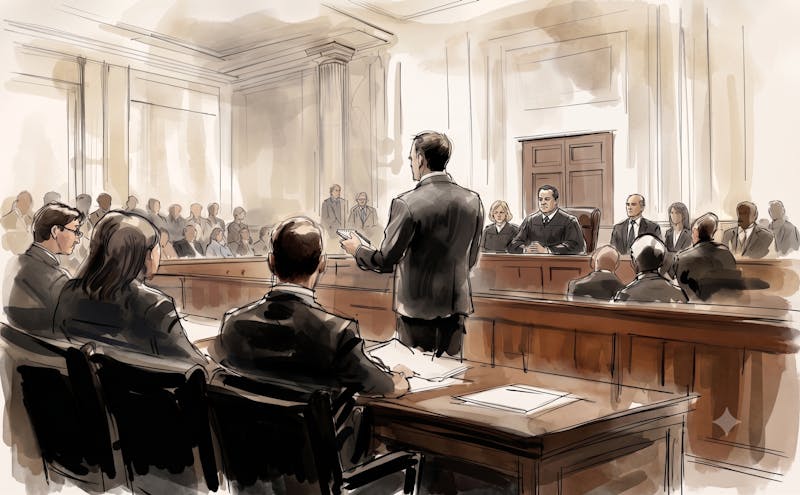
Closing argument is an attorney’s last opportunity to persuade the members before they deliberate—and often the moment that determines whether a case is won or lost. It is the counsel’s opportunity to bring the facts, testimony, exhibits, and governing law into focus; to explain how the pieces fit together; and to give the members a clear, compelling reason to reach the verdict your client seeks.
But that opportunity carries limits. Closing argument is not evidence or testimony, and it is not a vehicle for an attorney to place the weight of the Government’s office behind a witness or a preferred result. In recent years, military appellate courts have expressed increasing concern about attorney arguments that cross the line by asking members to decide a case based on counsel’s personal views, facts outside the record, improper pressure, or an accused’s exercise of protected rights.
Military Justice Attorneys (MJA) is committed to helping servicemembers understand their rights and protect their career, reputation, and future when facing allegations of misconduct. Our attorneys have defended servicemembers accused of some of the most serious offenses under the UCMJ and stand ready to fight for you today. If you are facing an investigation or court-martial, contact MJA today for a consultation.
The core rule: argue the record, not counsel’s authority
Effective advocacy identifies the evidence, explains why it matters, and leaves the ultimate judgment to the factfinder. An attorney may argue that a witness had a motive, that an account is corroborated, that a timeline is inconsistent, or that the admitted evidence supports a particular inference. Counsel may not personally certify that a witness is truthful, declare the evidence obviously correct, or suggest that the members should adopt counsel’s view because of counsel’s position.
A useful self-check might ask: Could this point be restated as “The evidence shows…” or “You may infer…”? If not, the argument may rest on counsel’s personal assertion rather than record-based reasoning.
The rule is straightforward but can be harder to apply in the moment. By closing argument, counsel has lived with the case—its witnesses, weak spots, and themes—for days, weeks, or longer. The instinct is to press every advantage. That is also when forceful advocacy can drift into impermissible advocacy: a personal assurance that a witness should be believed, a dismissive label for the other side’s theory, a suggestion that the defense had something to prove, or an appeal to concerns outside the record. The categories below highlight those recurring pressure points and offer a practical guide to staying on the right side of the line.
Common categories of improper argument
Vouching for witness credibility
Counsel may discuss credibility, including a witness’s bias, interest, motive, ability to observe, consistency, and corroboration. What counsel cannot do is personally assure the members that a witness is credible or truthful. That is vouching: placing the prestige of the Government behind the witness through personal assurances of veracity.
- Proper: “You may consider the witness’s contemporaneous report, the photographs, and the testimony of the responding officer when evaluating credibility.”
- Improper: “She is credible.” “You know she is telling the truth.”
The difference is consequential. The first formulation directs members to admissible proof. The second asks them to accept counsel’s endorsement.
Personal opinions about the evidence or guilt
Counsel should not inject personal belief into argument. Phrases such as I think, I believe, we know, it rings true, and it makes no sense risk turning counsel’s unsworn view into a substitute for evidence. The concern is especially acute when a prosecutor speaks because members may give undue weight to an opinion associated with the Government’s authority.
- Proper: “The account is consistent with the admitted photographs and the testimony concerning the bruise observed that day.”
- Improper: “I believe that the accused caused the bruising.”
Counsel can be forceful without becoming a witness. Use the evidence to establish why the requested inference is reasonable.
Disparaging an opposing counsel, an accused, or a defense theory
An attorney may challenge an argument’s logic and identify gaps between the theory and the evidence. Counsel may not use ridicule, name-calling, or loaded rhetoric to make an opposing theory appear absurd or to turn the trial into a contest over counsel’s personalities.
For example, calling a defense theory a “conspiracy theory” may be improper when the label supplies no analysis and merely makes the position appear fantastical. The better advocacy identifies the exact factual predicate the theory requires and explains why the record does—or does not—support it.
- Proper: “This theory requires you to find that the three witnesses independently misperceived the same event despite their contemporaneous observations.”
- Improper: “This is a ridiculous conspiracy theory.”
The same restraint applies to attacks on opposing counsel and the accused. Argument should address the evidence and the reasonable inferences—not a lawyer’s character or the accused’s worth.
Burden shifting and comments on silence
The Government bears the burden to prove guilt beyond a reasonable doubt. Argument cannot suggest that the accused must prove innocence, produce evidence, or personally explain the Government’s proof. Nor may counsel comment directly, indirectly, or by innuendo on the accused’s decision not to testify.
Attorneys should be particularly cautious with phrases such as the defense failed to explain, the defense offered nothing, or the accused could have told you. Context may matter, especially where counsel fairly responds to a defense assertion, but it is safer to focus on the Government’s affirmative proof and the actual logical weaknesses in an asserted theory.
- Proper: “The Government’s evidence establishes each element beyond a reasonable doubt.”
- Risky or improper: “The defense did not give you a reasonable explanation.”
Facts outside the record and misstatements of fact or law
Closing argument must stay within the admitted record and reasonable inferences from it. Counsel should not invoke excluded evidence, unadmitted facts, inflammatory hypotheticals untethered to the proof, or facts from other cases. Counsel must also accurately state the governing law and the record.
These errors undermine the adversarial process because the opposing party has not had a meaningful opportunity to confront, test, or rebut the asserted material. A disciplined argument outline should include record cites for factual propositions and a final check against the military judge’s instructions for legal propositions.
Appeals to passion, command influence, or consequences outside the case
Argument should not invite members to decide based on public reaction, command policy, the perceived needs of the military community, or the consequences the verdict may have beyond the evidence and instructions. Nor should counsel use command directives as leverage to compel a result. Such arguments divert the members from their responsibility to decide the case before them.
A practical checklist before argument
Before delivering findings or sentencing argument, counsel should ask:
- Record support: Can I identify the testimony, exhibit, stipulation, or authorized instruction supporting every factual assertion?
- Inference rather than endorsement: Am I asking members to draw an inference, or am I telling them what I personally believe?
- Burden and rights: Does any sentence suggest the defense must prove something or invite an inference from the accused’s silence or invocation of counsel?
- Tone: Does the argument explain why the opposing theory fails, rather than disparage counsel, the accused, or the theory itself?
- Scope: Have I avoided excluded material, outside facts, command-policy pressure, and predictions of consequences beyond the trial?
- Precision: Do my statements of law match the military judge’s instructions and the applicable rule?
CAAF’s reference list of improper arguments
The Appendix to the Court of Appeals for the Armed Forces’ decision in United States v. Matti, 2026 CAAF LEXIS 189, provides a non-exhaustive compendium of recurring improper arguments and related prosecutorial misconduct.
|
Category Identified in Matti |
Prohibited Advocacy or Concern |
| 1 |
Expressing Personal Beliefs and Opinions |
Interjecting a personal belief or opinion about the truth or falsity of testimony or evidence. |
| 2 |
Improper Vouching |
Placing the prestige of the Government behind a witness through personal assurances of the witness’s veracity, including personal pronouns paired with assertions that a witness should be believed. |
| 3 |
Offering Personal Views |
Providing substantive commentary on the truth or falsity of evidence, commenting on guilt, or offering unsolicited personal views of the evidence. |
| 4 |
Referring to Matters Outside the Record |
Departing from the record through, for example, inflammatory hypotheticals lacking an evidentiary basis or generalized assertions about unrelated victims or offenders. |
| 5 |
Commenting on Invocation of Constitutional Rights |
Asking members to infer guilt because the accused exercised a constitutional right. |
| 6 |
Referring to the Accused’s Right to Silence |
Treating silence as evidence of guilt, including through repeated “uncontroverted” or comparable references that are not tailored to a permissible response. |
| 7 |
Commenting on Invocation of the Right to Counsel |
Treating an accused’s request for counsel as substantive evidence of guilt. |
| 8 |
Commenting on Failure to Testify |
Directly, indirectly, or by innuendo commenting on the accused’s decision not to testify. |
| 9 |
Using the Providence Inquiry to Prove Other Offenses |
Using an accused’s guilty plea or providence inquiry to bolster the Government’s proof of a separate offense. |
| 10 |
Shifting the Burden to the Accused |
Suggesting that the accused must prove innocence or criticizing the defense for failing to produce evidence. |
| 11 |
Making Personal Attacks |
Argument that unduly inflames the passions or prejudices of the members. |
| 12 |
Attacking Counsel |
Encouraging a decision based on counsel’s personal qualities or maligning opposing counsel to win favor with the members. |
| 13 |
Attacking the Accused |
Disparaging the accused personally, including using pejorative labels or calling the accused a liar. |
| 14 |
Disparaging the Defense Theory |
Using disparaging rhetoric, rather than reasoned analysis, to make the defense theory seem fantastical. |
| 15 |
Public Reaction |
Asking members to predicate their verdict on the likely effect of the outcome on military-civilian relations. |
| 16 |
Misstating the Facts |
Making material misstatements of fact in summation. |
| 17 |
Misstating the Law |
Misstating a legal principle during argument. |
| 18 |
Associating the Accused With Other Offensive Conduct or Persons |
Linking the accused to other offensive conduct or persons without evidentiary justification. |
| 19 |
Citing Other Cases |
Arguing facts from other cases or appellate decisions with facts that parallel the case being tried. |
| 20 |
Citing Excluded Evidence |
Referring to excluded evidence rather than limiting argument to record evidence and fair inferences. |
| 21 |
Citing Command-Policy Directives |
Using a policy directive as leverage to compel a trial result or purporting to speak for the convening authority or another higher authority. |
| 22 |
Diverting Members From the Evidence |
Predicting consequences of a verdict or otherwise diverting members from deciding the case on the evidence. |
The bottom line
A proper closing argument is both persuasive and disciplined. It connects the evidence to the elements, identifies reasonable inferences, and respects the members’ independent role as factfinders. An improper argument substitutes counsel’s authority, emotion, or material outside the record for that disciplined analysis.
The most reliable rule for practitioners is also the simplest: argue from the evidence, not from yourself.
Military Justice Attorneys (MJA) represents servicemembers facing investigations, courts-martial, and administrative separations for alleged UCMJ violations. If you are facing adverse action, contact MJA today for a consultation.